

A Calgary teen turned fruit peels into a plastic-free farming solution
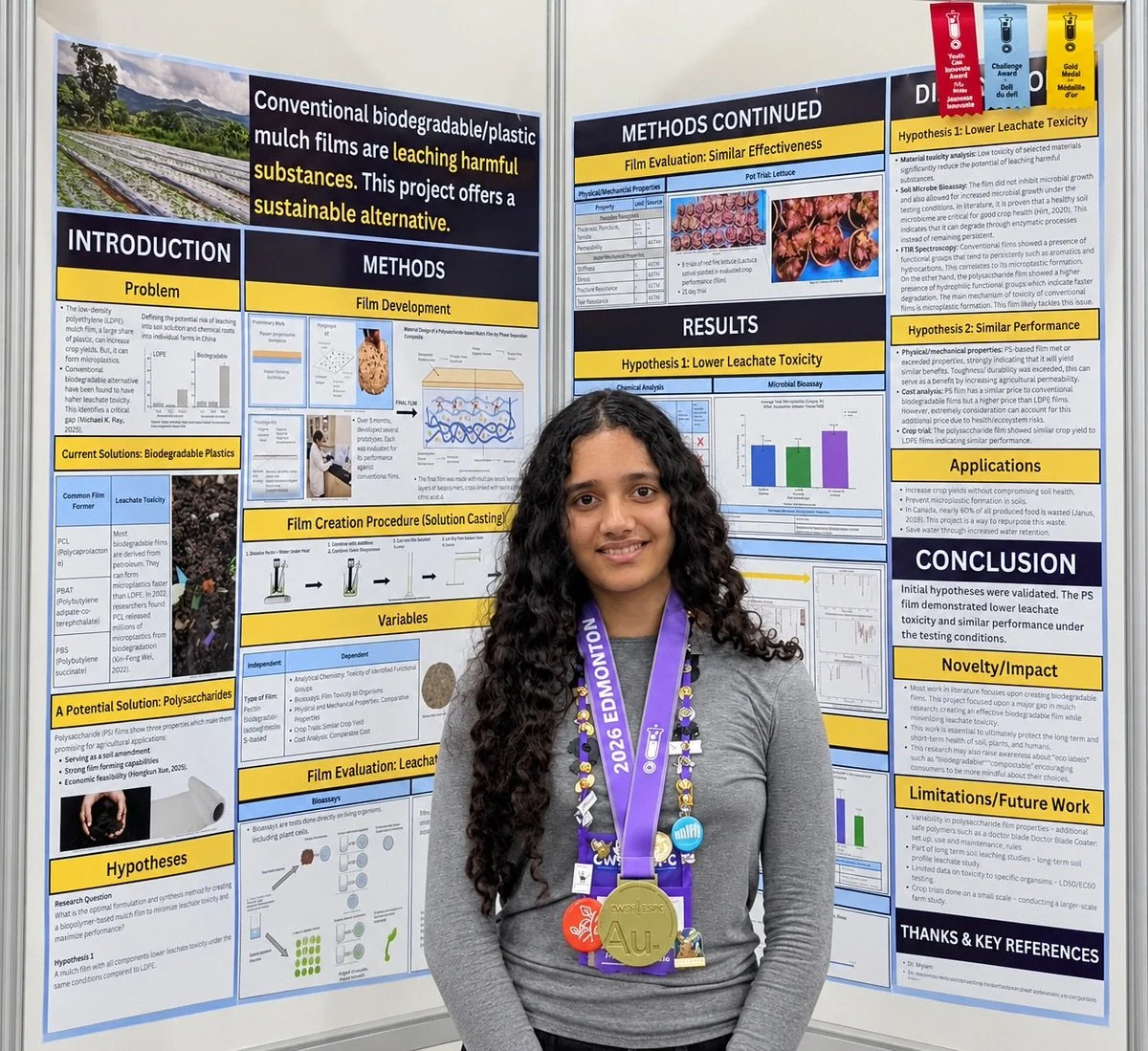
Gayatri Sakharkar in front of her poster at the Canada-Wide Science Fair. Photo by: Shruti S. Kulkarni
By Patricia Lane & Gayatri Sakharkar
Gayatri Sakharkar has invented a substitute for agricultural plastic film that leaves no toxic trace because it is made from orange and pineapple peels. This 15-year-old, Grade 10 student from Calgary won silver in the 2026 Canadian Youth Science Fair competition and is a recipient of the 2026 NYCAA from the Institute for Sustainability Education and Action (I-SEA)
Tell us about your project.
Gardeners and farmers use commercially available plastic film to help face worsening droughts, heat and aggressive pests. Most film degrades into microplastics that pollute crop soil and our bodies. Even “biodegradable” options often fail to break down in soil and leave harmful residues even if they are industrially composted later. My solution avoids these risks entirely.
My film is made from pineapple and orange peels, eggshells, cellulose derived from waste paper and leaves. I’ve tested it in university labs and through planting experiments, proving it boosts soil productivity just as effectively as commercial alternatives.
The cellulose and calcium from eggshells give the film strength, while pineapple peels add flexibility and orange peels provide pectin to hold it together. Unlike traditional films, mine degrades harmlessly in the soil, leaving no toxicity behind.
This fall I will be continuing my research at a lab at the University of Calgary to further understand the properties of the film and prepare for potential commercialization.
Free to read on National Observer - no sign-in required